A Becomes a Box Man
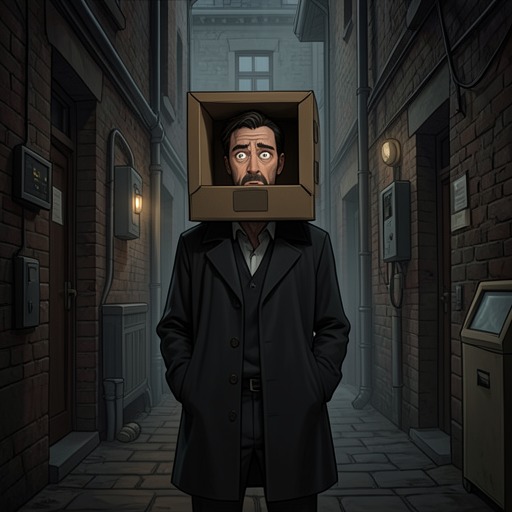
The Box ManA Becomes a Box Man is the embedded case of a man whose effort to expel a box man from the space below his apartment window becomes the beginning of his own departure from ordinary life. A’s change does not follow a declaration or a single settled decision: it gathers through the unease of watching, the uncertain aftermath of a shot, and the unexpectedly domestic shelter of a cardboard carton. The episode turns a confrontation over territory into a conversion, while leaving the consequences of the shot unresolved.
Background and Confrontation
A first encounters the box man as an unwanted presence directly below his apartment window. He tries not to look, but the stranger’s visibility from his room makes avoidance difficult. A feels that his territory has been illegally encroached upon and expects someone else to intervene. The neighborhood offers no such response: people behave as though they cannot see the box man, and A’s complaint to the building janitor achieves nothing. The stranger’s apparent ability to remain where he is, while escaping the notice or action of others, leaves A alone with a problem that seems at once public and private.
A eventually goes to the police box. Instead of resolving the matter, the bored officer tells him to complete a damage report and asks whether he has made it clear that the stranger should leave. A experiences this exchange as a new kind of fear. The official procedure does not supply an effective means of action, yet the officer’s response pushes the burden back onto him. On his way home, A stops at a friend’s house and borrows an Air Rifle.
The Shot and Its Uncertain Aftermath
Back in his room, A smokes and calms himself before looking directly out the window. The box man turns the observation slit toward him. With only three or four yards between them, the box tilts and its translucent window covering parts down the middle; an indistinct eye faces A. The reciprocal gaze makes the stranger more than an object in the street. A opens the window, loads the rifle, and takes aim, but hesitates over where to shoot and what the consequences might be. He wants the man to leave without bloodshed, yet cannot persuade himself simply to wait.
A fires. The box leaps, then settles. There is no cry or verbal response of the kind A had anticipated; instead, he sees movement within and tries to infer where the shot landed. Because the box conceals its occupant’s posture, A cannot tell whether his aim struck the man or how seriously he may have been hurt. The box man slowly rises, proves unexpectedly tall, stretches, coughs, and walks away, the box swaying as he turns. A cannot make out what the man seems to say, and the stranger disappears around a corner without revealing his face. The departure gives A no clear answer about the shot, and he is disappointed not to have seen the man’s expression.
Afterward, A notices cigarette ends, an empty bottle, crumpled chocolate wrapping, and several dark marks on the ground. He wonders whether the marks are blood, then decides they are probably spit or phlegm. That conclusion does not establish what happened; it marks A’s attempt to settle an uncertainty the departing figure has left behind. The encounter ends without confirmation of the box man’s condition, but not, for A, with the matter itself.
From Watching to Living in the Box
About half a month later, A has nearly forgotten the stranger, though he avoids the narrow lane on his way to the station and continues looking out of his window when he wakes and when he returns from work. The altered route and repeated checks show that the encounter persists as a habit even when he thinks he has moved on. The turning point comes when a new refrigerator arrives in a corrugated-cardboard carton of a convenient size. With the appliance removed, the empty box brings back the sound of the shot and the thought that its bullet has somehow returned to him.
A considers disposing of the carton, but instead draws the curtains and crawls inside. Its darkness and the smell of waterproof paint make the space feel homelike. He stays less than a minute before coming to his senses, then keeps the box. The following day he cuts an observation window into it and tries it over his head, but removes it almost immediately. He kicks it into a corner in anger, stopping short of destroying it. On the third day he looks out through the opening again. The familiar room seems altered: its ordinary objects take on a prickling edge, and A recognizes a tension he had not noticed before. Rather than discard the box, he begins to regard his prejudice against it as something he might set aside.
The next day he watches television with the box over his head. From the fifth day onward, he stays inside it whenever he is in his room, except when sleeping or attending to ordinary needs. The arrangement feels more natural and more like home than the solitary life he had been leading. On the first Sunday, he realizes that the box lacks what he needs for a more sustained retreat. He goes into town for a chamber pot, flashlight, thermos, picnic set, tape, wire, hand mirror, poster colors, and food that requires no preparation, then reinforces the carton and stores the supplies inside.
A hangs the mirror on the inner wall and uses the flashlight to paint his lips and circle his eyes in the colors of the rainbow. In the reflection his face appears more birdlike or fishlike than human. He imagines himself becoming the contents suited to the container. The box has moved from a discarded package, to a hiding place, to a space he furnishes and inhabits; the episode records this change through practical adjustments as much as through A’s shifting perception.
Departure and Significance
The following morning, after only a week, A goes stealthily out into the streets with the box over his head and does not return. His departure makes the change more than an experiment confined to his room: he takes the box into public space and leaves his former life behind, though the account does not specify what happens to him afterward. The swift movement from a brief trial indoors to an unannounced exit gives the ending its unresolved force.
The case also reframes the opening confrontation. A had treated the box man as an illegal intrusion and imagined that a threat or a shot could make him go away; instead, the encounter unsettles A’s own sense of what home and ordinary life can provide. The surrounding account presents box men as visible yet commonly ignored, and describes an anonymous city in which people might move among strangers without the usual defensiveness. A’s transformation gives that imagined freedom a personal, costly form: he becomes one of those who can disappear from familiar social expectations, but the text neither declares that his choice is wholly liberating nor explains its ultimate outcome. Its warning against pointing a gun at a box man acquires an additional irony in A’s case: the attempt to force the stranger away does not restore the old boundary between observer and observed.